BABY
What Is the Rooting Reflex?
Learn all about the newborn reflex that ensures your little one can always find their next meal!

Written by
Holly Pevzner

Newborns are not the blank slates you may think they are! In fact, babies burst onto the scene already preloaded with so many helpful reflexes to get them through early infancy. One of those newborn reflexes is called the rooting reflex—and it plays a starring role in keeping your bug nourished. Here’s everything you need to know about the rooting reflex, including when the rooting reflex develops and when to be concerned.
What is the rooting reflex in babies?
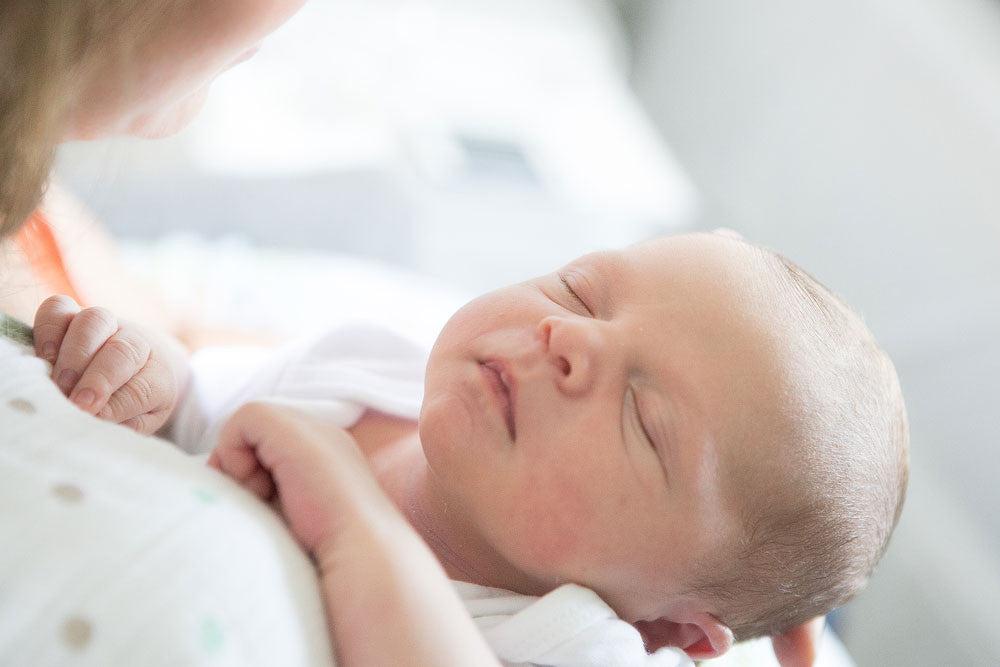
Thanks to the rooting reflex, your baby will instinctively turn their head, open their mouth, and thrust their tongue to seek nourishment when their mouth is touched. This reflexive action helps newborns find a food source—whether the breast or bottle—and proceed to eat…even when it’s too dark to see. (Primate babies do this, too!) The rooting reflex is one of many involuntary movements or actions that babies are born with, collectively dubbed newborn reflexes, or more formally, frontal release reflexes.
What triggers the rooting reflex?
While the rooting reflex is designed to be prompted by the soft tickle of the breast or bottle on Baby’s lips, any slight touch to the corner of your baby’s mouth—or the cheek near their lips—can initiate the rooting reflex. But don’t worry if you stroke your bub’s cheek and they don't respond with knee-jerk suckling! Rooting is a smart reflex, which means it’s only activated when your infant is hungry, according to pediatrician and The Happiest Baby on the Block author, Dr. Harvey Karp. That said, sometimes no touch is needed to kickstart the rooting reflex. Merely smelling breastmilk can cause your baby to start rooting!
How long does the rooting reflex last?
Your baby’s rooting reflex first appears at approximately 28 weeks gestation and lasts until their frontal lobe, which, in part, manages muscle control and movements, is more fully developed at about 4 to 6 months old.
How is the rooting reflex different from the sucking reflex?
Even though both of these newborn reflexes help babies get enough to eat, they work differently. The rooting reflex is often activated when you touch the corner of your bub’s mouth and the sucking reflex is triggered when your baby places their cherub lips around the areola, making sure the nipple is far back in their mouth—and aimed where the hard and soft palate meet. Once in position, your baby squeezes the breast between their tongue and the palate, forcing breastmilk out. Next, your hungry bug will dart their tongue from the areola to the nipple to keep the milk flowing.
Even though sucking is a newborn reflex that babies are born with (it appears around 30 to 35 weeks), coordinating these specialized movements along with breathing and swallowing is a tricky task for a newborn! That means, not all babies suck efficiently at first, according to the American Academy of Pediatrics (AAP). If your little one is having difficulty, never hesitate to reach out to your child’s healthcare provider or a skilled lactation consultant.
What does it mean if Baby doesn’t have a rooting reflex?
Sometimes the rooting reflex in premature babies is not quite developed enough to be present at birth, especially if your little one arrives before 28 weeks. Not having the rooting reflex from birth is often one of the reasons premature babies have difficulty feeding, according to research in PLOS One.
Less frequently, the absence of a rooting reflex could be a sign that your little one has hypotonia, which is abnormally low muscle tone that gives babies a “rag doll” quality when held. Hypotonia can be a condition on its own (congenital hypotonia) or it might indicate a muscle or genetic disorder or an issue with the central nervous system.
While your baby’s pediatrician will assess your little one’s newborn reflexes—including the rooting reflex—it’s important to flag any delays, changes, or worries you may have regarding your baby’s rooting reflex. The presence and strength of the rooting reflex is a clue indicating your bub’s nervous system is developing properly.
What happens if the rooting reflex doesn’t go away?
Research has shown that when the rooting reflex lingers for longer than 6 months—and is accompanied by drooling, a tongue that sits too far forward, difficulty swallowing and chewing, and/or other enduring newborn reflexes—this may be a sign on a developmental delay or a disability, such as cerebral palsy, autism, or a rare disorder called congenital trigeminal anesthesia. If you are concerned, don’t hesitate to reach out to a doctor!
Other Newborn Need-to-Knows
- Dr. Harvey Karp Walks You Through Newborn Screenings
- The Best Newborn Sleep Tips and Habits
- Meconium: Your Baby’s First Poop, Explained
- How to Dress a Newborn
***
REFERENCES
- National Library of Medicine, StatPearls: Rooting Reflex
- Encyclopedia of Animal Cognition and Behavior: Rooting Reflex
- Newborn crawling and rooting in response to maternal breast odor. Developmental Science. November 2020
- Cleveland Clinic: Frontal Lobe
- American Academy of Pediatrics (AAP): Newborn Reflexes
- A novel sensor design for accurate measurement of facial somatosensation in pre-term infants. PLOS One. November 2018
- Boston Children’s Hospital: What is hypotonia?
- Impact of the orofacial area reflexes on infant’s speech development. Progress in Health Sciences. May 2014
- Cleveland Clinic: Rooting Reflex
Disclaimer: The information on our site is NOT medical advice for any specific person or condition. It is only meant as general information. If you have any medical questions and concerns about your child or yourself, please contact your health provider.




SHARE THIS ARTICLE
MOST LOVED
Sleepytime Sidekicks




More on Baby
About Holly Pevzner
Holly Pevzner is Happiest Baby’s Staff Writer. She specializes in creating parenting, pregnancy, health, nutrition, and family travel content. Her work—including essays, columns, reported features, and more—has appeared in outlets such as EatingWell, Family Circle, Parents, Real Simple, and The Bump. Before becoming a full-time writer, Holly held senior staff positions at Prevention, Fitness, and Self magazines, covering medical health and psychology. She was also a contributing editor at Scholastic Parent & Child magazine and a regular kids-health columnist for Prevention and First For Women magazines. Holly lives in Los Angeles with her husband, two boys, and terrier mix.