BABY
When Do Babies First Talk?
Here’s when to expect your bub’s first words.

Written by
Happiest Baby Staff
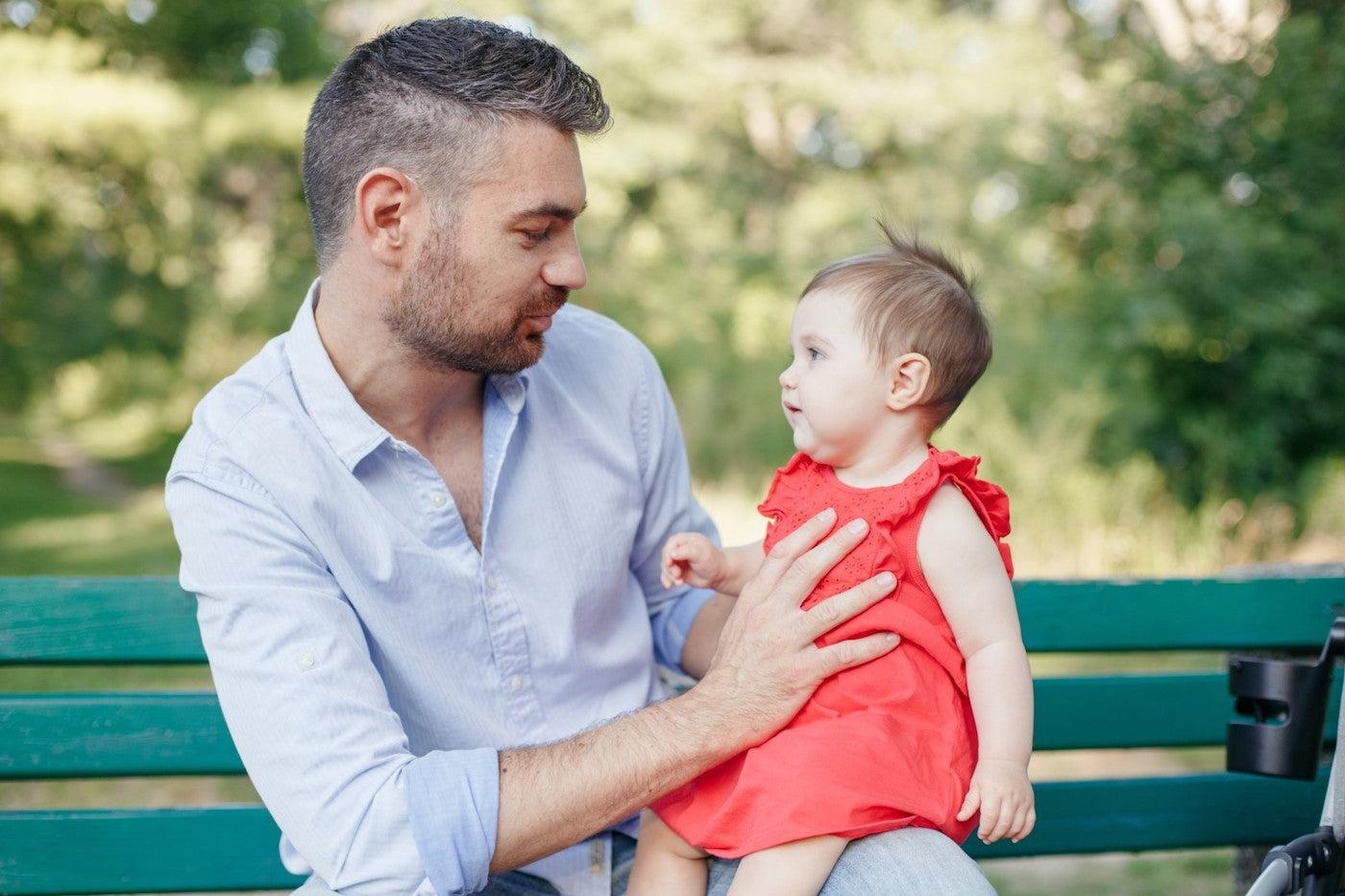
Your baby has been communicating with you from the day they were born—and we bet you quickly became skilled at understanding them, too! Still, it certainly helps when your baby begins talking and you two can truly speak the same language.
Babies can identify and understand words from as young as 5 or 6 months. Known as receptive language, this is an essential first step for their communication skills. From there, babies begin to work on vocalizing sounds, like the classic “goo-goo ga-ga.” But it takes a little bit more time and development before most babies can say their first words and build sentences.
When do babies say their first words?
Most babies say their first word between 12 and 18 months. Their first words are often both easy to identify and easy to say. Consonant sounds made with the lips, like “m” or “b,” tend to be the first step. That’s why you might hear “mama” before “dada.”
They may also use their own baby talk language, such as by calling a ball “baba.” Don’t spend too much energy on correcting them or getting them to pronounce the word correctly. Instead, respond with, “Yes, that is a ball!”
What are signs talking is near?
There is a pretty clear runway leading up to your baby’s first word. When they are just a few months old, they will likely work on vocalizing different sounds. We don’t give it much thought now, but we all had to learn how to physically speak! Coinciding with the babbling phase, your baby’s receptive language skills also improve during this time.
After practicing their speech abilities and studying what words mean, they will graduate to saying their first true words. (Here’s what talking looks like at 12 months.)
Still, babies often start off “slow and steady” with language for the first few months. Around 18 to 24 months, however, many babies begin experiencing a snowball effect with their vocabulary: They learn one word per week, then four words per week, then 20 words per week, and so on! Researchers attribute this to kids’ brains becoming more efficient at learning words by this point.
How can I help my baby learn to talk?
While your baby is processing the words they hear, they are also starting to recognize speech patterns and assign meanings to words. That’s why one of the best ways to help your baby learn to talk is by speaking to them.
How to Help Your Baby Talk
- Have “conversations” with your baby where you give them the chance to respond and then you react. This is shown to help develop the language centers in your child’s brain.
- Don’t shy away from baby talk. Research shows that the simplified, enthusiastic way of speaking with your baby that many parents subconsciously use does truly help with language development.
- Narrate what’s going on while spending time with your baby—talk about the things you are seeing while you are on a walk or what you are looking for in the house.
- Read books. Lots and lots of books! Not only is it great for bonding, but books can expose babies to words and contexts that they may not experience in life. This is shown to foster language and grammar development.
- Name pictures you point to, and ask your child to point to pictures that you name (they won’t be able to do this at first!). This is a great way to level up your reading game. And eventually, you can ask your child to name the pictures.
- Teach some baby signs, which can help your baby become enthusiastic about communicating and potentially make them more eager to speak.
- Use short words and sentences. This makes it easier for your child to mimic you. But use correct grammar!
- Add to words your child says. For example, if they say, “dog,” you can say, “yes! That’s a big white dog! The dog is walking so fast!”
Learn more about how babies learn to talk!
When should I be concerned if my baby isn’t talking?
According to the American Academy of Pediatrics, language delays affect one in five kids—and are the most common type of developmental delays among children. There are a number of possible causes for speech delays, which may resolve on their own or may require help from a specialist. If possible, early intervention can lead to the best outcomes.
If you are concerned that your child isn’t speaking like other babies or toddlers their age, pay attention to how they respond to noises, whether they seem to recognize words (like their name or “no”), how they communicate nonverbally, and if they are trying to communicate verbally.
If your child is experiencing both speech delays and other developmental delays, such as with social interactions or play, discuss what you’ve noticed with their doctor. For more specialized advice, you may consider asking for a referral to a speech professional.
When it comes to milestones for your baby, there is a range of what’s considered "typical" for development. By the nature of averages, that means many babies will hit these milestones before or after a certain point. If you have any concerns, don't hesitate to bring them up with your child’s pediatrician!
More on Baby Development:
- What’s New in the Toddler Years?
- An Age-by-Age Guide to Attention Span
- How Babies Learn to Play
- When Do Babies Walk?
- When Do Babies Climb?
***
REFERENCES
- University of Michigan C.S. Mott Children’s Hospital: Speech and Language Milestones, Birth to 1 Year
- American Speech-Language-Hearing Association: Birth to One Year
- Centers for Disease Control and Prevention: CDC’s Developmental Milestones
- American Academy of Pediatrics, Language Development: 8 to 12 Months
- American Academy of Pediatrics, Language Development: 1-Year-Olds
- Defusing the Childhood Vocabulary Explosion, Science, August 2007
- American Speech-Language-Hearing Association: One to Two Years
- Language Development: Talking With—Not Just to—Your Child, Children’s Hospital of Philadelphia Center for Childhood Communication, September 2019
- Quantifying Sources of Variability in Infancy Research Using the Infant-Directed-Speech Preference, Advances in Methods and Practices in Psychological Science, March 2020
- How Reading Books Fosters Language Development around the World, Child Development Research, February 2012
- American Academy of Pediatrics, Language Delays in Toddlers: Information for Parents
Disclaimer: The information on our site is NOT medical advice for any specific person or condition. It is only meant as general information. If you have any medical questions and concerns about your child or yourself, please contact your health provider.
SHARE THIS ARTICLE
MOST LOVED
Sleepytime Sidekicks